Lute raised $20M to put intelligence to work

Written by
Paweł Budzianowski, Krzysztof Walas
Lute has raised $20M in seed and pre-seed funding to put physical intelligence to work. We are backed by OTB Ventures, FORWARD.one, Credo Ventures, Seedcamp, Inovo VC, Naval Ravikant, Borusan Ventures and ff Venture Capital.
We started Lute in January 2026. Today we are excited to share our progress and what comes next.
World of Plenty
We believe physical AI will lead to economic abundance. Manufacturing, retail, logistics and health care employ about 1.4 billion people and produce about 40% of world GDP. Even so, in Europe and the US these sectors face growing labor shortages. Intelligent robots can turn these labor gaps into capacity.
Since 2022, AI has become far more capable. The next stage is to bring this intelligence into the physical world. But to deploy it at scale, we first have to close the gap between what robots and people can do. This is where our focus is.
We are excited to introduce Lute: a physical AI company building a new family of foundation models based on tactile input. We are putting them to work in retail stores, warehouses and third-party logistics.
Why touch
Most robots and physical AI models rely on vision only. Vision shows a robot where things are, but it says little about contact: how firmly the robot holds an item, whether the item is starting to slip, or how soft or fragile it is.
People feel these things with the sense of touch. You can feel a box start to slip from your grip before you see it move. This is why we bet on touch: it gives a robot the signals it needs to handle everyday items reliably.
Together with our partners, we co-designed compact, elastomer-based tactile sensors and built them into a custom portable data-collection setup.
With this setup, we are able to collect touch data at scale in any environment.
Introducing Lute-0
We are also introducing Lute-0, our first video-action model.
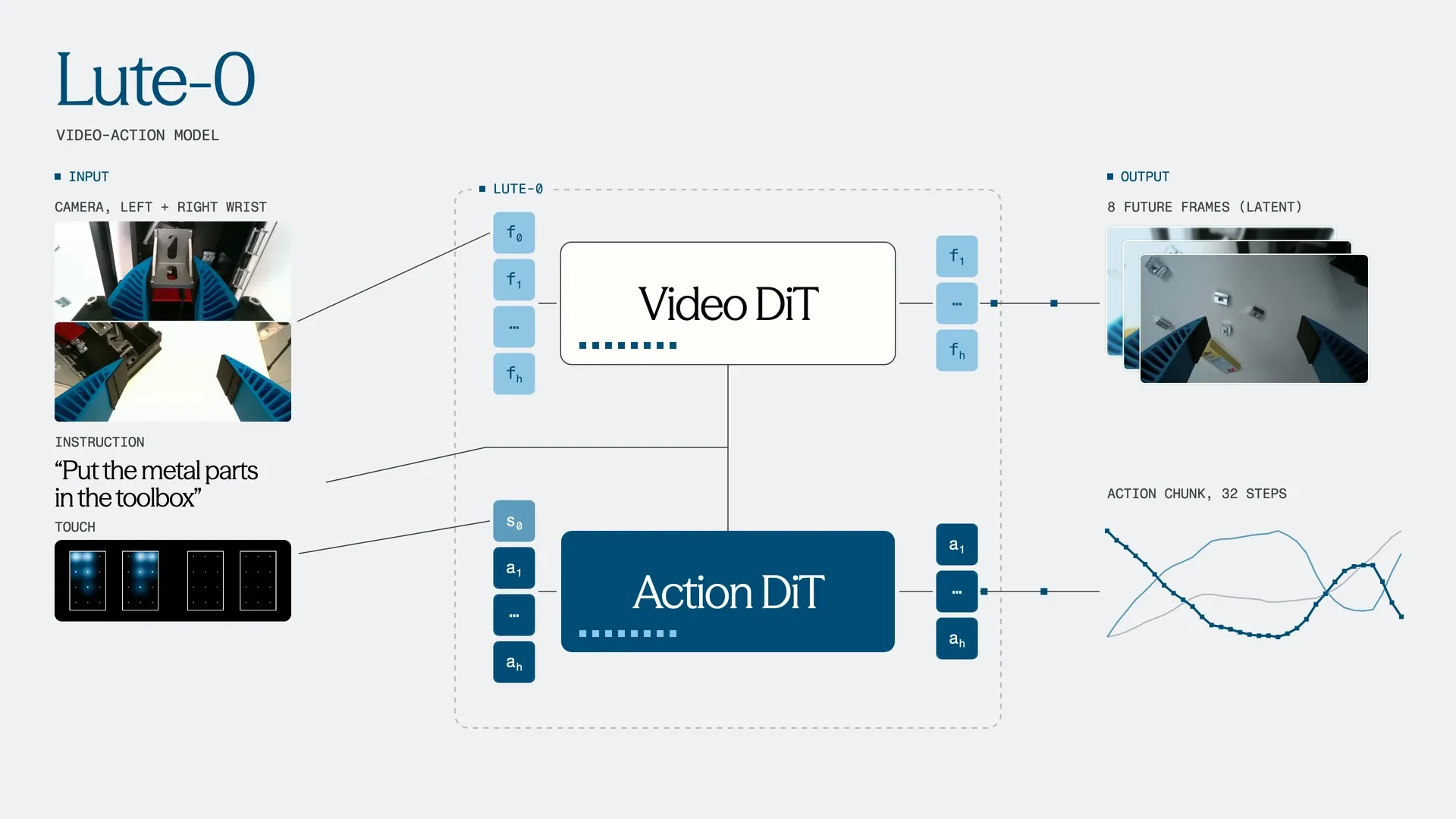
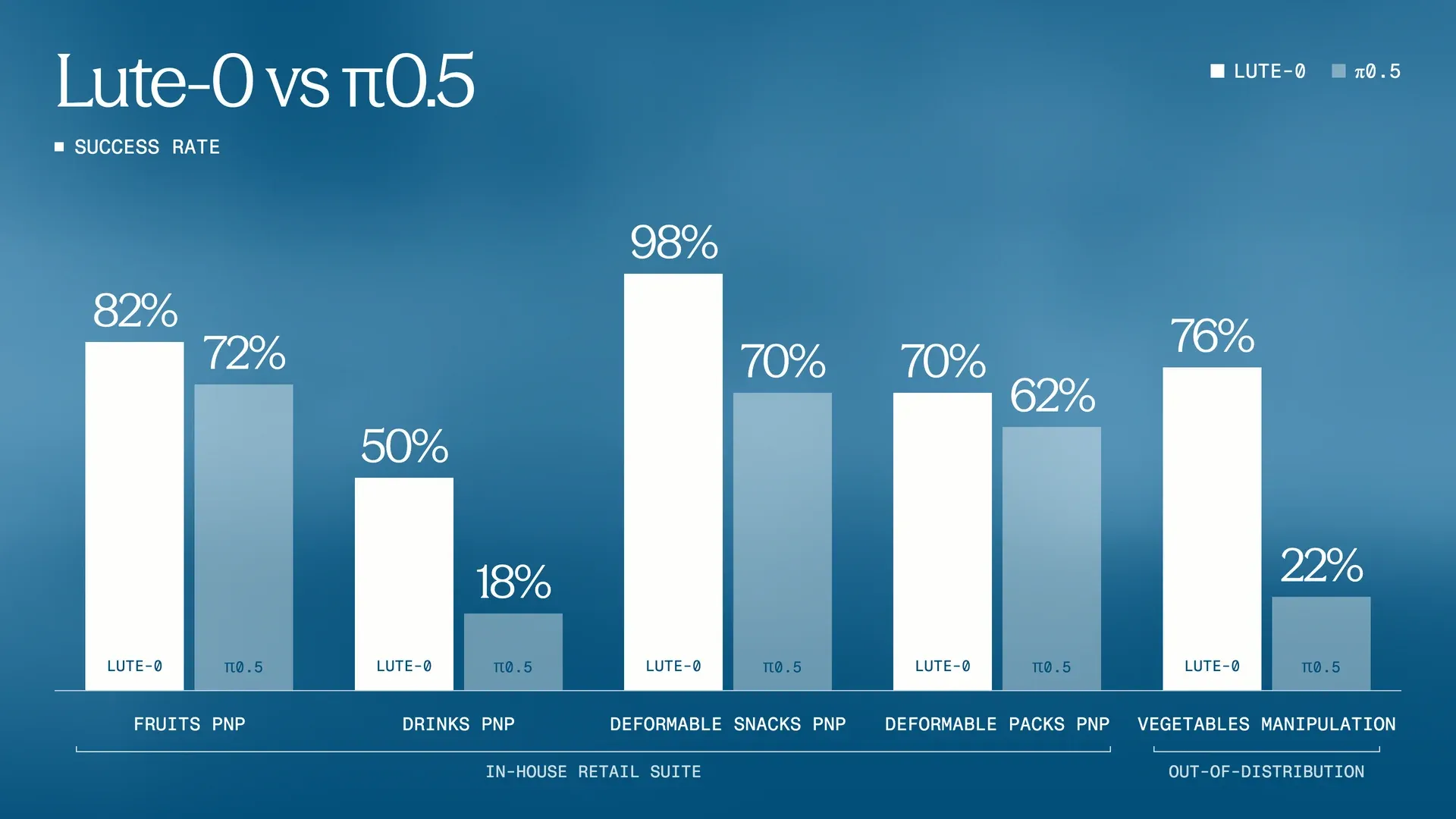
We pre-trained Lute-0 on far less data than π0.5, the leading open-source robot model, with a much faster training time. On a set of retail tasks, Lute-0 performed on par with or better than π0.5, with 2x better latency. We will be sharing more of our progress here soon.
Lute-0 is the first of a new family of foundation models that we are training on touch as well as vision.
Deploying intelligence
But a model alone isn’t enough. What matters is deployment. That’s where our focus was from the first day.
Just 10 months after the company started, our models already work at Europe’s largest automotive parts distributor. We work with some of the largest retailers in the world to put robots on their sites.
We are also partnering with integrators to bring our tech to the hardware they already install for their clients, starting from health care and manufacturing.
On site, autonomy handles the work whenever possible, and monitoring and remote human support step in when a robot needs help. Edge cases, failures and interventions flow back into training, so each deployment improves the next.
What’s next
Today we are announcing our $20M seed round co-led by OTB Ventures and FORWARD.one, including our pre-seed round led by Credo Ventures and Seedcamp, with participation from Inovo VC, Borusan Ventures, ff Venture Capital and Naval Ravikant.
We will use the funding to scale data acquisition, train and improve our models, and deploy with more customers.
“Many system integrators want to deploy AI-driven robots, but few have the machine learning expertise to do it. Lute removes that barrier. It guides integrators without in-house AI teams through selecting the right hardware, defining the task and retraining the robot on site, so they can put physical AI to work for their customers.” – Kris Pałucki, Investment Director at OTB Ventures
“I hear the word ‘urgency’ in almost every pitch. With Lute team, you feel it as soon as you walk into their lab. That extreme sense of urgency put Lute’s models onto real retail and logistics sites within months, because every hour on the shop floor teaches a model something no lab can, especially through touch. In physical AI, the slow and the perfect will both lose.” – Boy de Jonge, Investment Manager at FORWARD.one
Thank you to the Lute team for building all of this, and to our investors for backing us early.
Krzysztof and Paweł
We are hiring across research, engineering and deployment in Warsaw and San Mateo. See our open positions.